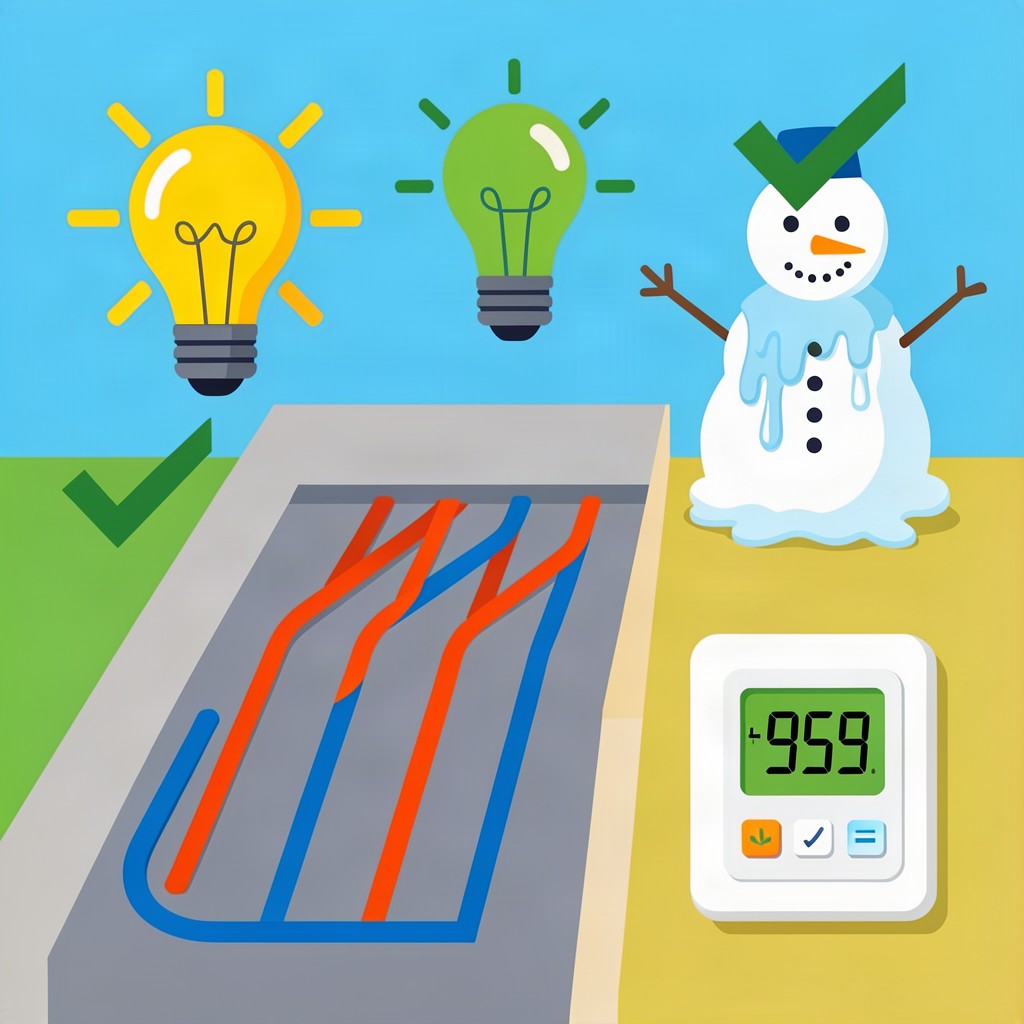
Is a heated driveway worth it? The answer is arithmetic. The model below takes the heated area, the annual snowfall hours, the storm count, the fuel type, and the boiler efficiency — and produces the annual operating cost against the plowing alternative.
| Driveway Heated Area (default: 1,000 sq ft) | Annual Snowfall Hours (default: 156 hours) | Estimated Number of Storm Events (default: 20 events) | Fuel Type (Natural Gas) | Natural Gas Cost per Therm (default: 0.50 per 100,000 Btu) | Boiler AFUE Efficiency Rating (default: 95%) | Professional Plowing Annual Cost (default: 2,000) | Turnkey Heated System Installation Cost (default: 14,000) | Source |
|---|---|---|---|---|---|---|---|---|
| 1,000 sq ft | 156 hours | 20 events | Natural Gas | 0.50 per 100,000 Btu | 95% | 2,000 | 14,000 | 1, 2, 3 |
The benchmark from the master guide: professional plowing and salting runs roughly 2,000 per season for a 1,000 sq. ft. surface, while a high-efficiency gas-fired hydronic system can operate for as little as 160 per year — a 90% reduction. Against a turnkey installation cost, that annual delta is the payback curve.
The short version
- The ROI model takes heated area, annual snowfall hours, storm count, fuel type and boiler efficiency, and outputs annual operating cost against the plowing alternative.
- Default inputs are 1,000 square feet of heated area, 156 annual snowfall hours, 20 storm events, natural gas at 0.50 per 100,000 Btu, a 95 percent AFUE boiler, 2,000 dollars of annual plowing and 14,000 dollars of turnkey installation.
- Professional plowing and salting runs roughly 2,000 dollars per season on a 1,000 square foot surface, while a high-efficiency gas hydronic system can operate for as little as 160 dollars a year, a 90 percent reduction.
- Against the 14,000 dollar turnkey installation cost, that annual operating difference is what defines the payback curve.
- Snowfall hours and storm event counts swing the outcome more than any other input, which is why regional data like the Vail profile matters more than national averages.
The model is only as good as its inputs — the snowfall hours and storm counts are the variables that swing the outcome, which is why regional data (like the Vail profile) matters more than national averages.